One of the biggest challenges in running a successful commercial cleaning business is figuring out how to price your services. Bid too low, and you eat into your profits—or worse, take a loss on the contract. Bid too high, and you risk losing the job to a competitor. The key to success lies in building a transparent, consistent, and data-driven pricing system.
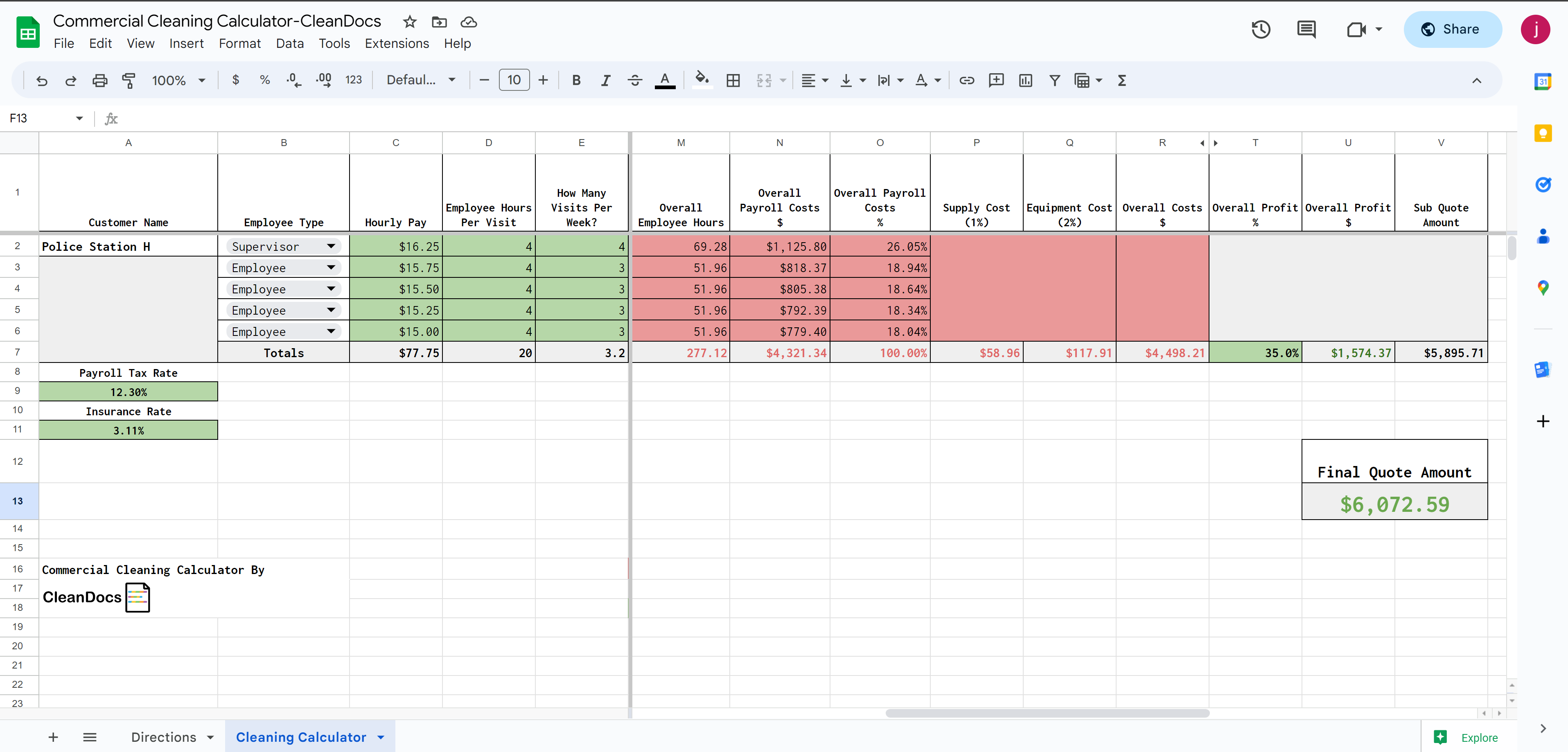
The screenshot above—taken from our Commercial Cleaning Calculator—shows exactly how this process works in practice. Let’s break it down step by step and explore how you can use tools like this to price smarter, improve profitability, and gain client trust.
Why Accurate Pricing Matters in Commercial Cleaning
Commercial cleaning contracts are often long-term and high-value. Even a small miscalculation in pricing can cost thousands of dollars over the life of an agreement.
-
Underpricing leads to razor-thin margins. You may win the contract, but you’ll struggle to cover payroll, insurance, and supply costs.
-
Overpricing makes you uncompetitive. Even if your service quality is excellent, many property managers and procurement officers will go with the lowest responsible bid.
Accurate pricing ensures that you’re profitable, sustainable, and competitive. That’s where calculators like this one come into play.
Step 1: Employee Pay and Hours
The foundation of any commercial cleaning quote is labor.
In the example:
-
Supervisor: $16.25/hr
-
Employees: $15.00–$15.75/hr
For this specific job (a Police Station), five staff members are needed, each working 4 hours per visit. Multiply that across the number of visits per week, and you begin to see the real scope of labor.
👉 This team will collectively work 277.12 hours per month.
Step 2: Payroll Taxes and Insurance
Many cleaning business owners forget about hidden labor costs. The calculator highlights two major ones:
-
Payroll Tax Rate: 12.30%
-
Insurance Rate: 3.11%
These percentages are added directly to your payroll burden. It’s not enough to just calculate “hourly pay × hours.” You must account for government obligations and liability protections.
👉 Payroll costs alone total $4,321.34 per month.
Step 3: Supply and Equipment Costs
Labor might be the biggest expense, but it’s not the only one. Cleaning supplies, tools, and equipment replacement all add up.
The calculator estimates:
-
Supplies: $63.52
-
Equipment: $127.03
👉 Total overhead from supplies and equipment: $190.55.
Step 4: Total Costs
Now, let’s add it all together:
-
Payroll Costs: $4,321.34
-
Supplies + Equipment: $190.55
-
Total Costs: $4,511.89
👉 This is your true baseline. Anything you charge below this number means you’re losing money.
Step 5: Profit Margin
Finally, you need to add profit. This is not “extra money”—it’s what keeps your business healthy and growing.
Profit covers:
-
Marketing and sales
-
Administrative costs (scheduling, accounting, office overhead)
-
Unexpected emergencies (equipment breakdowns, call-outs, supply shortages)
-
Your pay as the business owner
In the example, the calculator adds a 45% profit margin = $2,030.35.
👉 That brings the Final Quote Amount to $6,542.24 per month.
Why Transparency Builds Trust
When presenting a quote, you don’t need to share every line item. But having a system like this makes you confident in your numbers. It also allows you to explain your pricing logically if the client asks:
-
“We factor in payroll, insurance, supplies, and equipment.”
-
“Our profit margin ensures we can continue delivering reliable service.”
-
“Everything is calculated consistently, so you’re getting a fair and accurate price.”
This kind of transparency builds trust and professionalism.
Common Mistakes in Cleaning Pricing
-
Forgetting Payroll Taxes and Insurance – Adds 15–20% to labor costs.
-
Not Accounting for Supplies – Trash bags, mop heads, disinfectants add up fast.
-
Skipping Equipment Replacement – Vacuums and buffers wear out; you must budget for them.
-
No Profit Margin – Winning contracts without profit is not a win—it’s a slow drain.
How to Use a Calculator in Your Business
-
Build Templates: Pre-set formulas for offices, schools, gyms, etc.
-
Update Regularly: Costs rise—review payroll, insurance, and supply rates yearly.
-
Adjust Margins: Be flexible—competitive jobs may be 25%, premium contracts can support 40%+.
-
Train Your Team: Ensure sales reps and managers quote consistently.
Real-World Example: Police Station H
From the calculator:
-
Customer: Police Station
-
Staffing: 1 supervisor + 4 employees
-
Weekly Visits: 3.2 (≈14 per month)
-
Employee Hours: 277.12 monthly
-
Final Quote: $6,542.24
👉 That’s about $23.61 per labor hour—a competitive rate that balances client affordability and contractor profitability.
The Bigger Picture
Commercial cleaning isn’t just about mops and vacuums—it’s about running a sustainable business. Pricing is the backbone. A good calculator:
-
Protects your margins
-
Standardizes your quotes
-
Builds client confidence
-
Helps you scale strategically
Conclusion
The Commercial Cleaning Calculator shown here is more than a spreadsheet—it’s a roadmap for growth. By factoring in labor, payroll taxes, insurance, supplies, equipment, and profit margins, you ensure every quote is both competitive and profitable.
The goal isn’t just to win contracts—it’s to win profitable contracts.
If you’re serious about building a sustainable cleaning business, adopt a calculator-driven approach today. Your future growth depends on it.
If you would like to get the commercial cleaning calculator you can get it 👉 HERE